Welcome.

Please feel free to share your jewelry questions and comments with us, and visit the Garwood's website.

Wednesday, April 29, 2009

Gem Identification

Last week a customer brought in a vintage-looking necklace and earring set that she purchased at an estate sale. Although the 8x6 mm oval stones don't look like diamonds, she decided to test the stones with her at-home diamond tester. When the result was "diamond," she brought the set to us to verify her finding.

The stones have a very faint light blue color and few inclusions. Through closer inspection under a microscope, we determined the stones are definitely not diamonds, but were unsure of exactly what mineral they are.

All gemstones have multiple identifying characteristics. For instance, color is an easily seen characteristic. The type of inclusions, a stone's specific gravity, its crystal habit and fracture type and other things like refractive index and optic character are also used to identify stones. Because characteristics like color and fracture type can be the same in multiple gemstones, we have to look at all of them in combination.

In this case, our next step was to determine the stone's refractive index, which is the speed of light traveling through the stone versus light traveling through the air. Through the refractometer, we were able to narrow the stones down to a few minerals, but still were unsure.

We then used a polariscope to determine whether it was singly or doubly refractive and to determine its optic character.

Benitoite and chrysoberyl were possibilities, but based on all our findings, we found the gemstone to be corundum. Sapphires and rubies are varieties of corundum, and the mineral comes in nearly every color. Although our customer's gemstones don't look like a typical sapphire, they could be referred to as colorless sapphires.


Many gemstones are very easy for our trained gemologists to identify without this multi-step process, but we always find the detective work fun when we are presented with a stone such as this.

Tuesday, April 28, 2009

Hearts & Arrows: The Super Symmetry Ideal Cut Diamond

An ideal cut diamond is a diamond in which all areas of the stone have been cut to ideal proportions. This means every single facet needs to be a certain size and cut at a certain angle. This achieves the greatest brilliance and scintillation viewed as light returning to the naked eye.

The earliest ideal standard was developed by Marcel Tolkowski in the early 20th century. Today, only slight modifications from this original formula have changed. However, sophisticated computer technology has allowed us to achieve a super ideal cut known as the Hearts & Arrows ideal cut diamond.

A Hearts & Arrows diamond encompasses the latest technology in diamond cutting. CAD technology plays the lead role in designing such brilliant stones. The rough crystal image is loaded into sophisticated software that then maps out the best pattern of fashioning, all of which is done by computer-driven cutting wheels.

The result is a symmetrically perfect diamond that is strikingly more brilliant and fiery than a diamond graded as a good cut. This can be seen by a special viewing tool that allows the consumer to see a heart pattern when viewed down through the pavilion and an arrows pattern when the stone is facing up, thus the term Hearts & Arrows.

Hearts & Arrows is not a branded diamond. It is a term used to describe these perfectly symmetrical super ideal cut diamonds that exhibit this phenomenon. This model of perfection does command a higher premium, however, not as much as some branded ideal cut diamonds.
For more information visit www.heartsandarrows.com.

Wednesday, April 22, 2009

Reusing Gold

It may sound like a great idea to have grandma’s old wedding rings melted down and made into a new fashionable ring for you, but it’s not quite that simple.

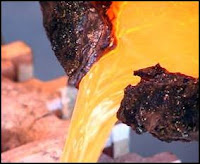
Because gold jewelry is not pure gold, it cannot simply be melted and reused. That said, very few jewelers have the equipment needed to properly process the gold. Simply melting the gold results in metal that is porous and brittle, which is not safe for everyday wear. Jewelry made form this metal will bend, break and exhibit an uneven pitted surface luster, or porosity. Thus, pieces made this way will not generally hold up well over time. To be safely reused, the gold must be refined, which is the process that frees the metal from impurities and unwanted materials.


While many jewelers will not melt your gold, it is not impossible to find one who will. Some may do it in their store, but most likely they will send it to a refinery. But be aware: what you get back may not be the actual gold you took in. Often for time and monetary efficiency, the jeweler will process a batch of jewelry rather than just your pieces and give you a portion of the refined gold. If it is important to you that you actually use grandma’s jewelry, ask about the jeweler’s process or consider doing something different.

A creative jeweler can help you find other ways to use grandma’s jewelry. Depending on the pieces, you may be able to add or subtract diamonds or gemstones to create a new look. In some cases you can take the top off a ring and fashion it into a pendant or create a pair of earrings if the design is symmetrical. Some wedding bands can be shaped into open heart pendants, and don’t forget that you can always set diamonds and gemstones into new mountings.

Your idea may not work exactly like you envision, but don’t be afraid to share your ideas with a jeweler and let him or her help you find a design that will be both visually appealing and a durable design.


-Photo from www.accountancypartners.co.uk

Monday, April 20, 2009

Finding a Jeweler

With so many types of jewelry stores, it can be hard to find one you trust. How do you know if they are reputable? Will they do a good job repairing your engagement ring? How do you know if their products are of good quality and made well?

The first thing to do is find a store that is a member of the American Gem Society (AGS).
In 1934, the founder of the Gemological Institute of America and other independent jewelers joined together to create the American Gem Society. They saw a need for an association dedicated to the highest possible standards of business ethics and professionalism in the jewelry industry. Today, AGS members continue this dedication by maintaining high levels of ethics, knowledge and consumer protection. Only a small percentage of jewelers who apply for AGS membership are awarded such, and AGS jewelers make up less than 5% of jewelers in the United States and Canada. This is because the qualifications for membership are stringent.

Shopping with an American Gem Society jeweler means you can shop with confidence. According to the AGS website, to be an AGS member, store owners and/or employees must have a high level of gemological knowledge including education through GIA or the Gemological Association of Great Britain. A store must "hold a reputation for unquestioned integrity in the business community and must be operated in a way that will enhance the confidence of the public in the jewelry industry." In addition to demonstrating financial stability for a minimum of two years, the owners must show that they are sincerely interested in high business ethics and run their store as such.

The American Gem Society also prohibits deceptive business practices, including the following:

  • Misleading advertising that is in any way untrue
  • Advertising or setting artificially high prices and passing them as the "regular price" to give consumers the idea of a sale price or supposed discount

When you shop at an American Gem Society jewelery store, you can rest assured that you will be assisted by educated and concerned jewelers.

Find an AGS member today: http://www.americangemsociety.org/member-search-jeweler.php